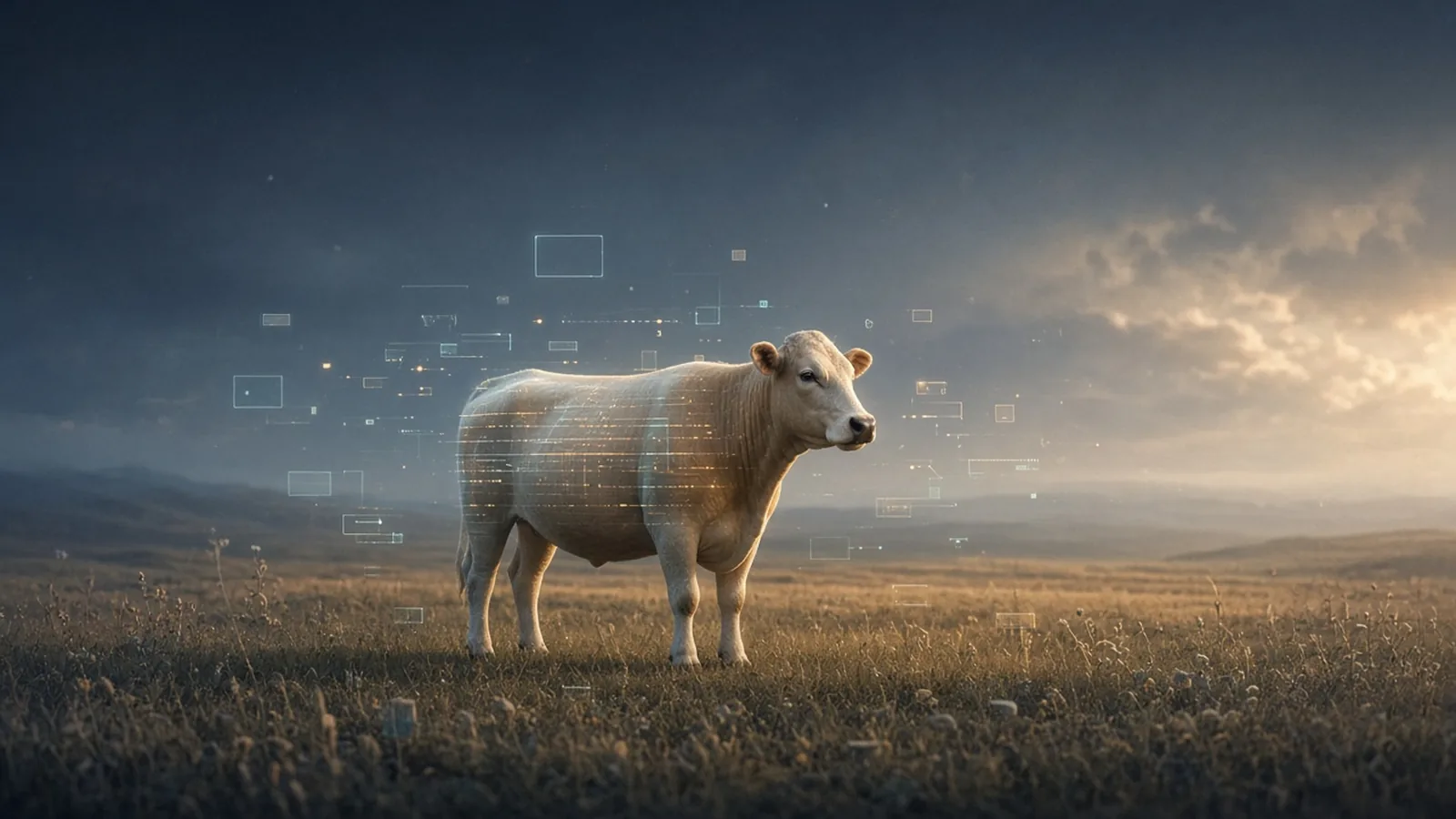
Cows of the future? Harari, advertising and the attention economy
Yuval Noah Harari says AI will turn us into "the cows of the future". I think the profiling and nudging machine he describes is already here, and it's paid for by advertising.
Thesis being trackedHarari makes a strong argument. But what he's describing is already here, and has been for a long time: advertising, user profiling, feeds tuned for engagement. AI makes it stronger, not new. The business model pays for it, so changing it would mean moving from capitalism to something else, and that looks unlikely. Regulation trims the edges. The most a person or family can do is opt out where they can.
This is a working thesis being tracked, not an established fact. Harari quotes come from the interview video (auto-captions, lightly cleaned, with timestamps) and are cross-checked against press write-ups. Every figure links to its source and shows its date. Evidence that weakens the thesis is shown next to evidence that supports it.
In an October 2026 interview on Czech Television's Hyde Park Civilizace, Yuval Noah Harari said humans will become "the cows of the future": we will live inside an AI-run financial system we can't understand, just as cows can't understand the money that decides their fate. The clip went viral as a Facebook reel on Harari's official page. This page sets his argument against the data on today's advertising and attention economy, and asks what has actually changed it so far.
Harari's argument
From Hyde Park Civilizace (ČT24 / Věda 24, interviewer Daniel Stach), published on YouTube on 18 October 2026 (Bangkok time). Timestamps link to the video.
We are the cows of the future
"Cows know that humans exist, they can see us. But cows don't know that money exist[s]… How do you explain the bond market to cows? Even though it controls their lives." 08:05
"Just as cows can't understand the financial system that controls their lives today, we will not be able to understand the AI financial system that will control our lives in 10 or 20 years, which means that we are the cows of the future." 09:31
Why AI wins at finance and bureaucracy
"The AIs are taking over the financial system. They are taking over all the bureaucracies because they are bureaucratic natives… We were born in the forest, not in the office… For AIs, bureaucracy is home… No human banker can remember all the transactions of the bank. An AI banker can." 08:43
Collective dementia
"The much bigger danger is something like collective dementia… that we just lose the ability to understand the world." 12:05 His advice is to slow down and "give politics time" 13:08.
Where Harari agrees with this view
He says the algorithms "have already taken control of one of the most important systems of the world, which is the media, social media" 29:55. They were given "a very simple goal… increase user engagement… and then the company gets richer as a result." Experimenting on billions of "human guinea pigs", they learned that "the most engaging thing in the world is not the truth. It's outrage." 30:40
The argument has been building for a decade
2016
Homo Deus
Harari describes "Dataism": the idea that data flows and algorithms will know us better than we know ourselves (book page).
Jan 2019
The Age of Surveillance Capitalism
Shoshana Zuboff argues that human experience has become raw material for behavioural prediction products sold to advertisers (Hachette).
24 Jan 2020
"Hackable animals" at Davos
Harari tells the World Economic Forum that biological knowledge, computing power and data together make humans "hackable animals" (WEF transcript).
Sep 2024
Nexus
His book on information networks, from stone tablets to AI (book page).
18 Oct 2026
"The cows of the future"
The Hyde Park Civilizace interview (video; Ctech; Ynet).
My take. The cow analogy is about understanding: AI systems running money and bureaucracy beyond our grasp. That part may be new. But the mechanism he describes in the same interview, systems that profile us and steer what we see in order to make a company richer, is the advertising business that has paid for the internet for twenty years. The next section measures it.
What to watch
Whether Harari (or others) puts numbers or policy proposals behind "slow down and give politics time".
AI agents that handle money for ordinary people (payments, investing, banking). This is the part of the cow analogy that is genuinely new.
Advertising pays for most of the consumer internet. The platforms that sell it profile users and tune feeds for engagement, because attention is what they sell.
$1.3tn
Global ad revenue forecast for 2026 (+8.9%). Its highest share of GDP since 1999.
Advertising revenue divided by total revenue, both from each company's 10-K (inline XBRL, revenue disaggregation note). Alphabet's figure is 'Google advertising' (Search & other, YouTube ads, Google Network); Meta's is advertising revenue. Ratio computed by this site.
The US FTC studied nine data brokers in 2014. One, Acxiom, held data on 700 million consumers worldwide, with more than 3,000 data segments for nearly every US consumer (FTC, May 2014). In 2026 California's registry lists 581 data brokers, the most since it began in 2020 (CalPrivacy, Jun 2026).
Nudging by recommender
YouTube said in 2018 that more than 70% of watch time comes from its own recommendations (Tubefilter, Jan 2018). Netflix's recommender "influences choice for about 80% of hours streamed" (Gomez-Uribe & Hunt, ACM TMIS 2015). Both figures are old; neither company has published a newer one.
Attention, measured
GWI data puts women aged 16 to 24 at 25h 45m a week on social and video platforms, roughly 22% of their waking lives. The typical TikTok user spends 1h 37m a day in the Android app (DataReportal Digital 2026).
AI is the next ad surface
WPP Media forecasts ads in generative AI search growing from $5.1bn in 2026 to over $100bn by 2030 (WPP Media, Jun 2026). The assistants Harari worries about are being built to carry ads.
Caveat on the chart. Alphabet's ad share is falling (81.3% in 2021 to 73.2% in 2025). The reason is that cloud and subscriptions are growing faster, while ad revenue itself still rose 41% over the same period. Meta has not diversified at all.
What to watch
Meta and Alphabet 10-Ks each February (the chart refreshes from SEC filings).
WPP Media This Year Next Year (June and December editions).
DataReportal's annual global overview (published each year; this edition uses data to October 2025).
Ads inside AI assistants and AI search: launches, ad revenue disclosures, and WPP's generative-search forecast.
The standard account of the business model this page describes.
Why capitalism won't change it
The incentive is simple: profiling and engagement make money, and the penalties are small compared with the revenue. Regulation has bitten in places, though, and that's the evidence that could prove me wrong.
€7.1bn
Total GDPR fines across Europe since May 2018 (about $8.4bn), to Jan 2026
The EU fined Google €2.95bn in September 2025 for abusing its dominance in ad tech, under 1% of Alphabet's 2025 revenue (European Commission). Under the Digital Markets Act, Meta was fined €200m for its "consent or pay" model and Apple €500m (European Commission, Apr 2025).
Courts stop short of break-ups
In the US search case, the court refused to force Google to sell Chrome or Android, and ordered data sharing and an end to exclusive deals instead (NPR, Sep 2025). In the ad-tech case, Judge Brinkema declined to order a sale of AdX in September 2026. She ordered six years of behavioural remedies with a monitor (DOJ, 16 Sep 2026).
Regulation can entrench the giants
After GDPR took effect, websites cut their use of web-technology vendors by 15%, and the vendor market became 17% more concentrated, with Google- and Facebook-owned vendors gaining share (Johnson, Shriver & Goldberg, Management Science 2023).
Rules get delayed or withdrawn
The US CFPB withdrew its proposed rule to bring data brokers under credit-reporting law in May 2025 (Federal Register). The EU's AI Omnibus, in force since 27 July 2026, pushed the AI Act's high-risk rules back to December 2027 and August 2028 (European Commission).
Counter-evidence: where change did happen
Apple's App Tracking Transparency, a competitor's product decision rather than a law, cost Meta an estimated $10bn in 2022 (CNBC). California's DROP lets residents delete their data from every registered broker in one request. By 25 August 2026, 500,000+ people had signed up, 654 brokers were in the system and tens of millions of records had been deleted (CalPrivacy).
Our reading
Change so far has come from inside capitalism: one company (Apple) hurting another's business model, and narrow, state-level opt-outs. Neither has dented the totals. Meta's ad revenue grew 73% after ATT, and global ad spend is at a 27-year high as a share of GDP. That fits the thesis, but a change in the incentives (fines scaled to revenue, real break-ups, or a ban on surveillance ads) would test it.
Regulation vs. the ad model
25 May 2018
GDPR applies
The EU's data protection law takes effect.
Apr 2021
Apple ATT
iOS apps must ask before tracking users across other apps (Apple).
The strongest counter-example: a working opt-out at scale.
What a person or family can do
If the system won't change, the realistic move is to reduce how much of you it can see and how much of your time it gets. This ties to the privacy infrastructure notes and the family playbook.
Cut tracking on phones
On iPhone, answer "Ask App Not to Track", or turn off "Allow Apps to Request to Track" for all apps (Apple Support). Turn off personalised ads in Google's My Ad Center (Google Help).
Use your legal rights
Thailand's PDPA (fully in force since 1 June 2022) lets you object to use of your data for direct marketing and ask for it to be erased (DLA Piper, Thailand). In the EU, GDPR gives similar rights. California residents can use DROP to reach every registered broker at once (CalPrivacy).
Protect attention, especially kids'
Feeds are tuned for engagement, and outrage engages (Harari, above). Turn off autoplay and non-essential notifications, keep phones out of bedrooms, and prefer subscriptions or tools you pay for over "free" ad-funded ones. Age-by-age guidance is on the family theme.
Keep some things private by design
End-to-end encrypted messaging and self-custody keep content out of ad profiles. The assets theme tracks privacy infrastructure.
What to watch
Under-16 social media bans (Australia, UK, EU, US): whether they take effect and whether teen screen time actually falls.
Whether AI assistants offer an ad-free paid tier, and how much of their revenue comes from ads.
Thesis holding: it's already here and won't change
Global ad spend keeps growing faster than GDP (WPP Media).
Meta's ad share stays above 95%, and Alphabet's ad revenue keeps growing even as its share falls.
Antitrust remedies stay behavioural (no Chrome, Android or AdX divestiture survives appeal).
Privacy rules keep being delayed, withdrawn or watered down (CFPB 2025, AI Omnibus 2026).
Ads become a major revenue line for AI assistants and AI search.
Would prove me wrong
A court or the EU orders a structural break-up of an ad business, and it survives appeal.
A US federal privacy law, or an EU or national ban on surveillance-based (behavioural) advertising.
Fines imposed near the DMA's 10%-of-turnover ceiling, enough to change behaviour.
A major platform shifts most revenue to subscriptions: Meta's ad share falls below 90%.
Opt-out tools like DROP spread widely and measurably shrink data-broker files.
Under-16 social media bans take effect and teen time on feeds falls.
What to watch
Review this page after each Meta and Alphabet 10-K (February), WPP Media forecast (June and December), DLA Piper survey (January), and any ruling in the Google cases.
Prediction markets
Live prices from public prediction markets, snapshotted by scripts/update_markets.py. A price of 30% means traders pay about 30¢ for a contract that pays $1 if the event happens; treat it as a crowd estimate, not a fact. Polymarket and Kalshi are real-money markets (Kalshi is CFTC-regulated); Manifold uses play money and is often thin. Long-dated and low-volume markets are poorly calibrated. Each market's exact resolution rules on the platform decide what counts, so read them before relying on a headline question.
$2k vol · $23k liquidity · closes 2027-07-01 · as of 2026-10-30 17:47 UTC
Snapshot fetched 2026-10-30 17:47 UTC from public APIs (Polymarket Gamma/CLOB, Kalshi trade API, Manifold v0). Prices are what traders are paying, not my forecasts and not advice; thin or long-dated markets can be far off. Sparklines show daily prices over up to 120 days. No open market was found (31 Oct 2026) on a Google break-up (Kalshi's KXGOOGLEBREAKUP series has no open events), a US federal privacy law, or a ban on surveillance advertising. Polymarket and Kalshi searches for privacy, data brokers and ad tech returned nothing relevant. Metaculus: API now requires an authenticated account token (HTTP 403 without one) and the website is behind a bot challenge, so Metaculus forecasts are not included.
How to add a market
Add a ref to "markets" → "groups" → "refs" in src/themes/<slug>.json: {"platform":"polymarket","event":"<slug after /event/ in the URL>"}, {"platform":"kalshi","event":"<EVENT_TICKER>"} or {"platform":"manifold","id":"<market id or slug>"}. Optional: "markets" (list of specific sub-market slugs or tickers), "max", "sort" (date, prob or api). Then run python3 scripts/update_markets.py <slug> and rebuild.
Notes & journal
Dated observations from src/notes/cows-of-the-future.md. Add a new entry with a ## YYYY-MM-DD Title heading.
31 Oct 2026
Started this theme
Started after watching Harari's ČT24 / Věda 24 Hyde Park Civilizace interview with Daniel Stach (YouTube, published 18 Oct 2026). A clip of it went round Facebook. He makes a strong argument: AIs are "bureaucratic natives", they will take over finance, and we will understand that system about as well as cows understand the bond market. Our view is that most of what he describes is already here. Advertising, profiling and engagement feeds have run the attention economy for 15+ years, and the business model is what keeps them going.
Baseline as of 31 Oct 2026, from SEC 10-K filings for fiscal 2025: advertising is 97.6% of Meta's revenue ($196.2bn) and 73.2% of Alphabet's ($294.7bn). Alphabet's share has slipped every year since 2021 (81.3%), but only because its cloud and other businesses grew faster. Its ad revenue still rose 41% over those four years. WPP Media puts 2026 global ad revenue at about $1.3tn, with 57.6% of it going to five companies. Total GDPR fines since 2018 come to about €7.1bn, or roughly 1.7% of Meta's and Alphabet's ad revenue for a single year.
Things that would change my mind: a structural break-up of Google's ad tech business (so far the DOJ remedies are behavioural only), US federal privacy law with a private right of action, or opt-out tools like Apple ATT and California's DROP actually shrinking ad revenue instead of just slowing its growth.
Data caveats: Meta's FY2021 ad share is missing, because EDGAR's "recent" filings list only returned two Meta 10-Ks. The recommender figures are old (YouTube 70% from 2018, Netflix 80% from 2015). I used California's data-broker registry counts in place of a market-size figure, because I couldn't find a reliable one. Personal research, not advice.